

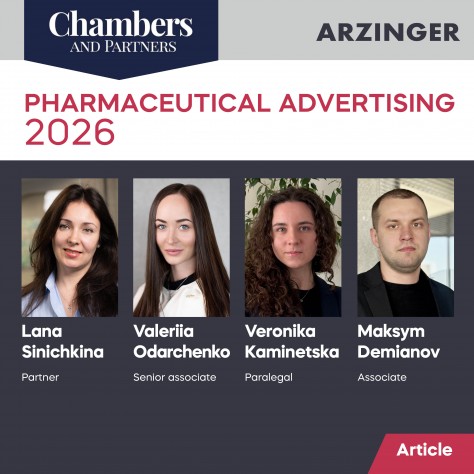
Lana Sinichkina, patner; Valeriia Odarchenko, senior associate; Maksym Demianov, associate; Veronika Kaminetska, paralegal
1. Regulatory Framework
1.1 Laws and Self-Regulatory Codes Concerning the Advertisement and Promotion of Medicines
In Ukraine, the advertising of medicinal products at the legislative level is regulated by:
- the Law of Ukraine “On Advertising” (No. 270/96-VR, as amended) that establishes the principles governing advertising activities in Ukraine and regulates the relationships arising in the process of producing, distributing and consuming advertising; and
- the Law of Ukraine “On Medicinal Products” (No. 123/96-VR, as amended) that regulates legal relations concerning the circulation of medicinal products in Ukraine and establishes specific requirements for their advertising.
In accordance with the requirements of these laws, a number of subordinate regulatory acts have been adopted, which are also mandatory in the advertisement of medicinal products. These include the Order of the Ministry of Health No. 457 dated 18 March 2024, which approved the List of OTC drugs prohibited from advertising, as well as the Order of the Ministry of Health No. 422 dated 6 June 2012, which establishes the criteria that are used to determine medicinal products, advertising of which is prohibited.
The promotion of medicinal products at the legislative level is regulated by:
- the Law of Ukraine “On Medicinal Products” that sets general requirements and restrictions on the promotion;
- the Resolution of the Cabinet of Ministers of Ukraine (CMU) No. 1759 of 26 December 2025, which is related to the provision of marketing and other services related to the sale of medicinal products to end consumers at the retail points of sale, as well as the provision of promotional services to the HCPs at the retail points of sale; and
- the Guidelines “Good Practice in the Promotion of Medicinal Products”, approved by Order of the Ministry of Health (MOH) No. 962 dated 12 June 2025, which sets forth methodological principles regarding the promotion of medicinal products and the conduct of medical and pharmaceutical professionals, rehabilitation specialists, as well as holders of marketing authorisations for medicinal products and their authorised representatives.
The Code of Ethics of the Association of Pharmaceutical Research and Development (hereinafter – the “APRaD”) serves as the Self-Regulatory Code in Ukraine.
It is worth mentioning that APRaD is a non-governmental and non-profit organisation, founded to represent the interests of the research-based pharmaceutical industry, to contribute to improving healthcare for Ukrainian citizens, and to promote the protection of the legal and economic climate in Ukraine. The members of the APRaD are companies that are leaders in the development, research and production of innovative medicinal products, which are present in Ukraine. Therefore, the Code of Ethics only applies to those member companies and could be considered as a guide for other companies that are not members of the APRaD but wish to operate in compliance with the best industry practices.
1.2 Application and Influence of Self-Regulatory Codes on the Advertisement and Promotion of Medicines
The APRaD Code of Ethics applies to the member companies of the Association of Pharmaceutical Research and Development that are engaged in the promotion of medicinal products in Ukraine. In practice, APRaD member companies (manufacturers of innovative medicinal products) are obliged to adhere to and apply the provisions of this code in their operations. In particular, some companies include in their contracts, as a mandatory contractual provision, a condition that the counterparty must conduct its activities under the agreement in such a way as to prevent complications in the company’s compliance with the requirements of the APRaD Code of Ethics. In addition, companies use the Code of Ethics requirements as a guide when developing their internal policies and, accordingly, implement its requirements as best practices.
It should be noted that compliance with the APRaD Code of Ethics is not a prerequisite for contracting with the national health service or participating in the public procurement of medicinal products. The Code functions as soft law – it is binding only on member companies and is not directly enforceable by state authorities. However, in practice, adherence to the Code is increasingly viewed as a benchmark of corporate governance in the pharmaceutical sector.
1.3 Regulatory Updates
In 2025, the key changes in Ukrainian legislation governing the advertising and promotion of medicinal products were the adoption of:
- the Resolution of the Cabinet of Ministers of Ukraine No. 1759 of 26 December 2025, which is related to the provision of marketing and other services related to the sale of medicinal products to end consumers at the retail points of sale; and
- the Guidelines on “Good Practice in the Promotion of Medicinal Products”, approved by Order of the MOH No. 962 dated 12 June 2025, which sets forth methodological principles regarding the promotion of medicinal products and the conduct of medical and pharmaceutical professionals, rehabilitation specialists, as well as holders of marketing authorisations for medicinal products and their authorised representatives.
It is noteworthy that during 2025 there was a temporary ban on providing marketing services, promotion services, informational services, or any other services related to the sale of medicinal products to end consumers, which lasted from 1 March 2025, and ended on 29 December 2025.
Moreover, on 1 January 2027, the new Law of Ukraine “On Medicinal Products” (No. 2469-IX, adopted on 28 July 2022) will enter into force. With this law, the rules for advertising and advertising restrictions will be revised. It will also introduce specific provisions on the promotion of medicinal products.
In addition, in March 2026, the Law of Ukraine “On Veterinary Medicine and Animal Welfare” came into effect, establishing a separate regime for the advertising of veterinary medicinal products (introducing Article 21-1 of the Law of Ukraine “On Advertising”).
2. Scope of Advertising and General Principles
2.1 Definition of Advertising
Pursuant to Article 1 of the Law of Ukraine “On Advertising”, advertising is information about a person, an idea and/or a product, disseminated for monetary or other compensation, or for the purpose of self-promotion in any form and by any means, and intended to create or maintain, through direct (direct advertising, teleshopping) or indirect (sponsorship, product placement) means, awareness among consumers of the advertisement and their interest in such a person, idea and/or product. A key element of advertising is that it is addressed to an indefinite group of persons (advertising consumers).
Ukrainian law distinguishes advertising from several adjacent concepts, including promotion, product information and information about medicinal products.
“Promotion” differs from advertising primarily by its purpose and target audience. Under the Law of Ukraine “On Medicinal Products”, promotion is aimed at informing healthcare and pharmaceutical professionals and encouraging the prescription, dispensing, sale or use of medicinal products.
“Product information” under the Law of Ukraine “On Consumer Protection” is also excluded from the concept of advertising. Such information includes mandatory information about the product and may be provided on packaging, labels, accompanying documentation, at points of sale, on official websites or through remote communication means, including telecommunications networks. Information displayed at points of sale regarding the manufacturer or the product itself, including on retail equipment or product packaging, is likewise not considered advertising.
“Information about medicinal products” (including products that are not registered or are in the stage of development or introduction into production), in accordance with Article 26 of the Law of Ukraine “On Medicinal Products”, includes such categories of information as: name, characteristics, therapeutic properties and possible side effects published in publications intended for medical and pharmaceutical professionals, as well as in materials distributed at specialised seminars, conferences and symposia on medical topics. This information is also not considered advertising.
It is also worth noting that the new pharmaceutical regulatory framework introduced in 2025, including the Resolution of the Cabinet of Ministers of Ukraine No. 1759 dated 26 December 2025, further differentiates between advertising, promotion, marketing and other activities related to the sale of medicinal products to the end consumer. In particular, the new framework establishes distinct regulatory regimes and compliance requirements depending on the type of activity.
2.2 Information or Advertising: Disease Awareness Campaigns and Other Patient-Facing Information
Advertising is information about a person, an idea and/or a product, disseminated in exchange for monetary or other compensation or for the purpose of self-promotion, in any form and by any means, and intended to create or maintain, through direct (direct advertising, teleshopping) or indirect (sponsorship, product placement) means, awareness among consumers of the advertisement and their interest in such a person, idea and/or product (paragraph 15 of Part 1 of Article 1 of the Law of Ukraine “On Advertising”).
The key elements of advertising therefore include:
- (1) information about a person, idea and/or product;
- (2) information disseminated for monetary or other compensation or for the purpose of self-promotion;
- (3) any form and any method of disseminating information;
- (4) the purpose – to create or maintain, either directly (direct advertising, teleshopping) or indirectly (sponsorship, product placement), consumer awareness of the advertisement and their interest in such a person, idea and/or product; and
- (5) an undefined group of persons to whom the advertising is directed.
These elements should be assessed cumulatively when determining whether specific materials qualify as advertising.
Disease awareness campaigns, patient leaflets and patient support programmes (PSPs) are not automatically considered advertising. Their qualification depends on the content, purpose, target audience and manner of dissemination.
In practice, patient-facing informational materials and PSP-related communications are generally viewed as non-promotional where they are limited to providing educational or support information, do not encourage the purchase or use of a specific medicinal product and are addressed to a defined group of persons, such as enrolled PSP participants.
At the same time, each disease awareness campaign or patient support initiative should be assessed individually, taking into account its specific content and implementation model, as Ukrainian legislation does not provide for a blanket exemption for such activities from advertising regulation.
2.3 Restrictions on Press Releases Regarding Medicines
Ukrainian legislation does not specifically regulate press releases relating to medicinal products. Accordingly, whether a press release qualifies as advertising must be assessed on a case-by-case basis, taking into account its content, purpose, target audience and manner of dissemination.
In practice, corporate or investor-oriented press releases containing factual and non-promotional information are generally less likely to be treated as advertising. By contrast, materials disseminated to the general public that contain promotional claims regarding a medicinal product may fall within advertising regulation.
It should also be taken into account that advertising of prescription-only medicinal products is prohibited in Ukraine. Over-the-counter medicinal products may be advertised provided they are not included in the list of medicinal products prohibited from advertising approved by the Ministry of Health of Ukraine.
In addition, Ukrainian advertising legislation imposes substantial content restrictions on medicinal product advertising. For example, advertisements may not contain:
- references to guaranteed therapeutic effects;
- statements discouraging consultation with healthcare professionals;
- claims suggesting self-diagnosis or self-treatment;
- references to a product as being the safest, most effective or free from side effects;
- endorsements by healthcare professionals or celebrities; or
- misleading information regarding a product’s composition, efficacy or origin.
At the same time, these restrictions do not apply to information published in specialised medical or pharmaceutical publications or distributed at scientific and medical events intended exclusively for healthcare professionals.
2.4 Comparative Advertising for Medicines
Comparative advertising is permitted in Ukraine and is regulated primarily by the Laws of Ukraine “On Advertising” and “On Protection Against Unfair Competition”.
In accordance with the definition contained in the Law of Ukraine “On Advertising” (Article 1) and the Law of Ukraine “On Protection Against Unfair Competition” (Article 7), comparative advertising is advertising that contains comparisons with other persons and/or the goods (or activities) of another person, and directly or indirectly identifies a competitor or the goods or services offered by a competitor.
Comparative advertising is allowed provided that it:
- does not contain elements of unfair business practices;
- does not constitute unfair competition;
- does not mislead consumers;
- is not aggressive;
- objectively compares essential, comparable and representative characteristics of homogeneous (similar) goods;
- does not discredit and does not contain false information;
- with regard to a product bearing an indication of origin, the comparison is made with a product bearing a similar indication;
- does not create confusion between the advertiser (its goods) and the competitor (its goods); and
- does not depict the competitor’s goods, protected by a trademark or trade name, in a manner that imitates them.
Ukrainian legislation expressly allows the use in comparative advertising of references to a competitor’s products, trademarks and trade names where necessary for the comparison.
In the pharmaceutical sector, comparative advertising is additionally subject to the general restrictions applicable to medicinal product advertising.
3. Advertising of Unauthorised Medicines or Unauthorised Indications
3.1 Restrictions on the Provision of Information Concerning Unauthorised Medicines or Indications
As a general rule, Ukrainian law prohibits the advertising and promotion of unregistered medicinal products, as well as the promotion of unauthorised indications.
At the same time, Ukrainian legislation distinguishes advertising from the provision of information about a medicinal product. Under the Law of Ukraine “On Medicinal Products”, information concerning medicinal products that are not yet registered or are still under development may be disseminated exclusively through publications intended for healthcare and pharmaceutical professionals or within specialised medical and scientific events, including seminars, conferences and symposia.
Such information may include, among other things, the medicinal product’s name, characteristics, therapeutic properties and possible adverse effects. However, it should remain informational and scientific in nature and should not constitute promotional communication directed at the general public.
Accordingly, the permissibility of providing information regarding unauthorised medicines or indications in Ukraine largely depends on the target audience, the context and the manner of dissemination.
3.2 Provision of Information During a Scientific Conference
Under the Law of Ukraine “On Medicinal Products”, information regarding medicinal products that are not registered in Ukraine or are still under development may be disseminated in materials distributed at specialised medical seminars, conferences and symposia intended for healthcare and pharmaceutical professionals.
Such information may include:
- the medicinal product’s name;
- characteristics;
- therapeutic properties; and
- possible side effects.
In practice, the information should remain scientific and professional in nature and should not constitute promotional communication directed at the general public.
Ukrainian legislation does not establish separate rules for international scientific conferences. Accordingly, the same general principles apply irrespective of whether the conference is local or international, provided that the information is addressed exclusively to healthcare professionals.
3.3 Provision of Information to Healthcare Professionals
Under the Law of Ukraine “On Medicinal Products”, information regarding medicinal products that are not registered in Ukraine or are still under development may be disseminated exclusively to healthcare and pharmaceutical professionals through professional publications and materials distributed at specialised medical seminars, conferences and symposia. Such information may include, among other things, the medicinal product’s name, characteristics, therapeutic properties and possible adverse effects.
3.4 Provision of Information to Healthcare Institutions
Under Ukrainian law, there is no specific regulation expressly governing the provision of information concerning unauthorised medicinal products or unauthorised indications to healthcare institutions for budget planning, procurement preparation or similar institutional purposes.
At the same time, the Law of Ukraine “On Medicinal Products” permits the dissemination of information regarding medicinal products that are not registered in Ukraine or are still under development to healthcare and pharmaceutical professionals through professional and scientific channels. Such information may include the medicinal product’s name, characteristics, therapeutic properties and possible adverse effects.
In practice, the provision of non-promotional scientific or pipeline-related information to healthcare institutions may be permissible where:
- the information serves a legitimate scientific, medical or planning purpose;
- the communication is factual, balanced and non-misleading;
- the information is not intended to promote the prescription, purchase or use of the medicinal product prior to authorisation; and
- the communication does not constitute advertising or promotion of an unauthorised medicinal product.
3.5 Information About Early Access or Compassionate Use Programmes
Ukrainian legislation allows certain forms of early access to unauthorised medicinal products through:
- expanded access programmes for unauthorised medicinal products; and
- post-trial access programmes for investigational medicinal products following completion of a clinical trial.
Such programmes are subject to approval by the Ministry of Health of Ukraine.
Information regarding approved programmes is publicly available through the relevant Ministry of Health orders, which include key details such as the programme type, duration, healthcare institutions involved, general patient criteria, medicinal product information and the provider of the medicinal product.
At the same time, Ukrainian legislation does not contain detailed rules specifically regulating the publicity or promotion of compassionate use or early access programmes. In practice, communications regarding such programmes should remain informational in nature and should not constitute the advertising or the promotion of unauthorised medicinal products to the general public.
In addition, patients participating in such programmes (or their legal representatives) must receive sufficient information from the treating physician regarding the objectives, methods, potential risks, expected outcomes and available treatment alternatives before providing informed consent to participate.
4. Advertising to the General Public
4.1 Main Restrictions on Advertising Pharmaceuticals to the General Public
Ukrainian legislation imposes substantial restrictions on the advertising of medicinal products to the general public.
Advertising of prescription-only medicinal products is prohibited. In addition, over-the-counter (OTC) medicinal products may only be advertised if they are not included in the list of medicinal products prohibited from advertising approved by the Ministry of Health of Ukraine.
The advertising of doping substances and methods of their use in sport, as well as advertising of traditional medicine (healing) services to the general public, is also prohibited.
In addition to product-specific restrictions, Ukrainian law establishes detailed content requirements for medicinal product advertising. In particular, advertisements may not:
- refer to therapeutic effects in relation to difficult-to-treat or incurable diseases;
- suggest that medical consultation is unnecessary;
- guarantee therapeutic effects;
- encourage self-diagnosis or self-treatment;
- present a medicinal product as the safest, most effective or free from side effects;
- contain testimonials, recommendations or endorsements from healthcare professionals, scientists or celebrities;
- include images of healthcare professionals or persons imitating them;
- contain misleading information regarding a product’s composition, efficacy, origin or patent protection; or
- suggest that a medicinal product is a foodstuff, cosmetic or other consumer product, or that its efficacy derives from its natural origin.
Ukrainian legislation also prohibits advertising that may create fear regarding the non-use of a medicinal product or exploit consumers’ lack of medical knowledge.
These restrictions do not apply to materials disseminated exclusively through specialised medical or pharmaceutical publications or at scientific events intended solely for healthcare professionals.
4.2 Information Contained in Pharmaceutical Advertising to the General Public
Advertising of medicinal products directed at the general public is subject to detailed content requirements under Ukrainian law.
Advertisements must:
- contain objective information about the medicinal product;
- clearly indicate that the material is an advertisement and that the advertised product is a medicinal product;
- include a recommendation to consult a healthcare professional before use;
- include a recommendation to read the instructions for use; and
- contain the mandatory warning: “Self-medication can be harmful to your health.”
The mandatory warning must occupy at least 15% of the total advertising space or duration. In audio advertising, it must be voiced at least once per advertisement (and at least once per minute for longer advertisements) at the same volume level as the main message.
Ukrainian law also establishes extensive prohibitions regarding the content of medicinal product advertising. In particular, advertisements may not:
- guarantee therapeutic effects;
- discourage consultation with healthcare professionals;
- promote self-diagnosis or self-treatment;
- refer to a product as the safest, most effective or free from side effects;
- contain testimonials or endorsements by healthcare professionals, scientists or celebrities;
- use images of healthcare professionals or persons imitating them;
- contain misleading information regarding a product’s efficacy, composition, origin or patent protection; or
- suggest that a medicinal product is a foodstuff, cosmetic or other consumer product.
In addition, advertising may not exploit consumers’ fears regarding illness or non-use of a medicinal product.
All advertising claims remain subject to general consumer protection and unfair competition rules and must not be misleading. In practice, the Antimonopoly Committee of Ukraine takes a strict approach towards unsubstantiated superiority or leadership claims, including statements regarding the speed of action, efficacy, uniqueness or market leadership of a medicinal product, unless such claims can be adequately substantiated.
4.3 Restrictions on Interactions Between Patients or Patient Organisations and Industry
Ukrainian legislation does not prohibit interactions between pharmaceutical companies and patients, patient organisations, caregivers or advocacy groups, nor does it establish specific prior approval requirements or formalities for such interactions.
At the same time, these activities remain subject to a number of regulatory requirements, particularly regarding:
- references to medicinal products (given the risks related to advertising restrictions and unfair competition);
- collection, processing and disclosure of personal data, including sensitive health data and medical confidentiality;
- compliance with pharmacovigilance obligations when receiving safety-related information; and
- adherence to anti-corruption standards and ensuring fair market value for any compensation or reimbursement of travel, accommodation, meals or similar expenses.
In practice, interactions with patient organisations are also significantly influenced by industry self-regulation. In particular, the APRaD Code of Ethics establishes additional standards applicable to member companies, including requirements relating to transparency, documentation and appropriate conduct. In particular:
- Hospitality must be reasonable, limited to the main purpose of the event, and must not include entertainment activities.
- Gifts and promotional items for the personal benefit of patient organisation representatives are generally prohibited.
- Donations and grants may be provided only to patient organisations (not individuals) and solely for healthcare, research or educational purposes, and must not serve as an inducement to recommend or use specific medicines.
- Sponsorship and funding must be transparent, and companies may not require exclusive sponsorship arrangements.
- Services may be provided (eg, advisory boards, research participation, educational activities or market research) only where there is a legitimate documented need, under written contracts and with remuneration reflecting fair market value.
Any provided financial or non-financial support must be documented and publicly disclosed, including the nature and value of the support or services provided.
5. Advertising to Healthcare Professionals
5.1 Restrictions on Information Contained in Advertising Directed at Healthcare Professionals
Under Ukrainian law, advertising and promotional activities directed exclusively at healthcare professionals are subject to a significantly less restrictive regime than advertising directed at the general public.
Pursuant to Article 21 of the Law of Ukraine “On Advertising”, the statutory restrictions applicable to public advertising of medicinal products do not apply to materials disseminated through specialised medical or pharmaceutical publications or at medical seminars, conferences and symposia intended for healthcare professionals.
At the same time, where communications are aimed at promoting the prescription, dispensing, sale or use of a medicinal product, such activities are generally regarded as promotion and remain subject to pharmaceutical regulatory requirements.
The promotion of medicinal products must:
- apply only to medicinal products registered in Ukraine;
- include the necessary information in accordance with the instructions for use of the medicinal product;
- contain information about the dispensing category of the medicinal product;
- promote the rational use of the medicinal product by providing objective information about it, without exaggerating its properties;
- not be misleading (as defined in the Law of Ukraine “On Protection Against Unfair Competition”); and
- be conducted in accordance with good promotional practices for medicinal products.
At the same time, the promotion of medicinal products must not be accompanied by:
- the provision, in any form, of remuneration for the dispensing (sale) of medicinal products to consumers;
- offering or providing material incentives, bonuses, rewards, cash rebates, or the right to participate in any game, lottery, contest, or event, if the condition for receiving such benefits or participating is the dispensing (sale) of specific medicinal products by a pharmacist; or
- promising, offering or providing an improper benefit directly or through other persons to pharmaceutical workers.
Information in promotional materials must include, in particular, the following details:
- the date of creation or last revision of such materials;
- the date, author and source (original source) of their publication (in the case of references to research results); and
- on websites or individual web pages containing information intended exclusively for medical, pharmaceutical professionals and/or rehabilitation specialists — a clearly visible and unambiguous warning regarding restrictions on access to such information.
The content of the information in the promotional material must not contradict the marketing authorisation dossier for the medicinal product, prescription instructions and the accompanying information materials (package insert, information on the packaging, summary of product characteristics).
In practice, as a safeguard, companies commonly include disclaimers stating that the promotional materials are intended solely for healthcare professionals and relate to a specific medicinal product.
5.2 Reference to Data Not Included in the Summary of Product Characteristics
Ukrainian legislation does not expressly prohibit references in advertising or promotional materials to data that are not included in the summary of product characteristics (SmPC).
At the same time, all advertising and promotional materials must comply with the general requirements applicable to medicinal product advertising and promotion, including the requirements that the information be objective, accurate, not misleading and appropriately substantiated.
In practice, companies are generally expected to ensure that any claims used in advertising or promotional materials are supported by adequate evidence. The Antimonopoly Committee of Ukraine takes a particularly strict approach towards unsubstantiated or potentially misleading claims. Accordingly, references to clinical studies, scientific data or other materials not reflected in the SmPC should be carefully assessed and appropriately substantiated.
For materials directed at healthcare professionals, broader scientific and clinical information may generally be used, provided the communication remains compliant with the applicable rules governing promotion to healthcare professionals, as outlined above.
5.3 Advertising of Combination Products
Ukrainian legislation does not establish a separate regulatory regime for the advertising of combination medicinal products. Accordingly, medicinal products containing more than one active ingredient may be advertised subject to the general rules applicable to medicinal product advertising.
Such advertising must comply with the general requirements of Ukrainian advertising, consumer protection and unfair competition legislation, including the requirements that advertising be objective, accurate, fair and not misleading. In practice, advertising claims should also remain consistent with the approved product documentation and adequately substantiated.
Similarly, Ukrainian law does not contain specific rules governing the advertising of medicinal products together with companion or complementary diagnostics. Such communications are therefore assessed under the general advertising and unfair competition framework on a case-by-case basis.
5.4 Advertising of Companion Diagnostics
Ukrainian legislation does not establish specific advertising rules for companion diagnostics. The rules applicable to the advertising of medicines and of the relevant medical device should therefore be complied with.
Ukrainian law does not expressly prohibit references to information not included in the product documentation or intended use materials. However, in practice, any claims used in advertising should be adequately substantiated and should not mislead consumers regarding the characteristics, purpose or performance of the companion diagnostic product.
5.5 Restrictions on Reprints of Journal Articles for Healthcare Professionals
Companies may provide healthcare professionals with reprints of scientific or medical journal articles concerning medicinal products.
Where the dissemination of such materials is intended to promote the prescription, dispensing, sale or use of a specific medicinal product, the activity will generally be regarded as promotion and will therefore be subject to the rules governing promotion to healthcare professionals.
In particular, promotional materials should:
- relate only to medicinal products registered in Ukraine;
- include the necessary information in accordance with the instructions for use of the medicinal product;
- contain information about the dispensing category of the medicinal product;
- promote the rational use of the medicinal product by providing objective information about it, without exaggerating its properties;
- not be misleading (as defined in the Law of Ukraine “On Protection Against Unfair Competition”); and
- comply with good promotional practices for medicinal products.
In practice, companies typically include references to the source, author and publication date of the article, as well as appropriate disclaimers indicating that the materials are intended exclusively for healthcare professionals.
The dissemination of journal articles must also comply with the general restrictions applicable to promotion, including prohibitions on improper inducements or incentives for healthcare professionals.
5.6 Medical Science Liaisons
Ukrainian legislation does not specifically regulate Medical Science Liaisons (MSLs) as a separate category distinct from medical or sales representatives.
In practice, pharmaceutical companies may employ personnel performing MSL-type functions, particularly in the context of scientific exchange with healthcare professionals. However, the distinction between promotional and non-promotional activities is critical from a regulatory perspective.
Under the Law of Ukraine “On Medicinal Products”, activities aimed at promoting the prescription, dispensing, sale or use of a medicinal product are regarded as promotion and are subject to the applicable pharmaceutical advertising and promotion rules. Promotion is generally limited to medicinal products registered in Ukraine.
Accordingly, personnel performing promotional functions are not permitted to proactively discuss unauthorised medicinal products or unauthorised indications with healthcare professionals in a promotional context.
At the same time, Ukrainian legislation permits the dissemination of scientific and professional information regarding medicinal products that are not yet registered or are still under development through professional publications and materials distributed at specialised medical seminars, conferences and symposia intended for healthcare and pharmaceutical professionals.
In practice, personnel performing MSL-type functions may generally engage in non-promotional scientific exchange with healthcare professionals, including reactive discussions regarding unauthorised medicines or indications, provided that:
- the communication remains scientific and non-promotional in nature;
- it is addressed exclusively to healthcare professionals; and
- it does not constitute promotion of an unauthorised medicinal product.
6. Vetting Requirements and Internal Verification Compliance
6.1 Requirements for Prior Notification/Authorisation of Advertising Materials
Ukrainian legislation does not require prior authorisation or notification of medicinal product advertising materials by a regulatory authority.
At the same time, companies may seek advisory opinions from the Antimonopoly Committee of Ukraine under the Law of Ukraine “On Protection of Economic Competition” where advertising or promotional activities may raise potential unfair competition or misleading advertising concerns. Such opinions are voluntary and are not equivalent to formal pre-approval of advertising materials.
6.2 Compliance With Rules Concerning Medicinal Product Advertising
In practice, pharmaceutical companies operating in Ukraine typically implement internal compliance procedures governing the creation, review and approval of advertising and promotional materials and activities. Such procedures are often aligned with global corporate policies and supported by dedicated approval systems and IT platforms.
Moreover, Ukrainian regulatory authorities, particularly the Antimonopoly Committee of Ukraine, generally regard the existence of internal policies, standard operating procedures and other compliance mechanisms aimed at identifying and mitigating antitrust and related regulatory risks as good compliance practice. In practice, the existence of such compliance frameworks may be considered a positive factor in the context of regulatory investigations and the assessment of a company’s overall compliance efforts.
Advertising and promotional materials are commonly subject to multi-functional review involving, among others, medical, legal, compliance, regulatory, marketing and communications functions before dissemination or launch. External counsel is also frequently involved, particularly where global or regional materials require localisation and assessment for compliance with Ukrainian pharmaceutical advertising, consumer protection and competition law requirements.
Companies also typically maintain internal processes for monitoring compliance and promptly withdrawing or correcting materials where potential inaccuracies or regulatory concerns are identified.
7. Advertising of Medicinal Products on the Internet
7.1 The Advertisement of Medicinal Products on the Internet
The general rules governing medicinal product advertising in Ukraine apply equally to online advertising and digital communications.
Accordingly, prescription-only medicinal products may not be advertised to the general public, while over-the-counter medicinal products may be advertised unless they are included in the list of medicinal products prohibited from advertising approved by the Ministry of Health of Ukraine.
Online advertising of medicinal products must comply with the general advertising requirements outlined above, including the obligation to ensure that advertising is objective, clearly identifiable as advertising and accompanied by the mandatory health warning.
In addition, Article 14-2 of the Law of Ukraine “On Advertising” establishes specific requirements for advertising disseminated through video-sharing and information-sharing platforms. In particular:
- advertising content on such platforms must be appropriately labelled; and
- platform providers are prohibited from processing children’s personal data for targeted advertising and similar commercial purposes.
Further, under the Good Promotion Practice requirements, websites or webpages containing information intended exclusively for healthcare professionals should include a clear and visible disclaimer restricting access to professional audiences only.
In addition, the Law of Ukraine “On Electronic Communications” establishes anti-spam requirements applicable to electronic advertising and marketing communications. In particular, unsolicited mass distribution of electronic, text or multimedia messages without the recipient’s prior consent is prohibited. Advertising communications sent by electronic means (including email, SMS and similar channels) generally require the recipient’s prior consent and must provide recipients with a clear and simple mechanism to withdraw such consent and opt out of further communications at any time.
It is also worth noting that the new version of the Law of Ukraine “On Consumer Rights Protection” (adopted but not yet in force) introduces additional rules regarding misleading online commercial practices. In particular, presenting products in a higher ranking in internet search results without clearly indicating that such placement constitutes advertising or paid promotion will qualify as a misleading commercial practice. These provisions are expected to become applicable after the termination or cancellation of martial law in Ukraine.
7.2 Restrictions on Access to Websites Containing Material Intended for Healthcare Professionals
Under the Good Promotion Practice requirements, websites or webpages containing information intended exclusively for healthcare professionals, pharmaceutical professionals or rehabilitation specialists must include a clearly visible and unambiguous disclaimer restricting access to such information.
Ukrainian legislation does not prescribe a specific technical mechanism for restricting access and does not require mandatory password-protected access. In practice, however, pharmaceutical companies commonly implement access-control measures such as:
- self-certification gateways;
- healthcare professional confirmation pop-ups;
- registration-based access systems; or
- permanent disclaimers on relevant webpages.
Typically, access to professional materials is granted only after the user confirms their healthcare professional status or logs into a restricted-access section of the website.
7.3 Provision of Disease Awareness Information to the General Public Online
Under Ukrainian law, disease awareness materials are generally not regarded as advertising provided they remain informational in nature and do not promote a specific medicinal product, company or brand.
In practice, disease awareness campaigns are generally permissible where they focus on education regarding symptoms, diagnosis, prevention or treatment approaches without promoting a specific medicinal product.
The key consideration is whether the communication contains the characteristics of advertising, in particular whether it is intended to create or maintain consumer interest in a specific product.
Accordingly, disease awareness materials should avoid:
- references to specific medicinal products, especially prescription-only medicines;
- promotional claims regarding efficacy or superiority;
- direct or indirect encouragement to purchase or use a particular product; and
- content that may qualify as misleading advertising.
7.4 Virtual Scientific Meetings
Virtual scientific meetings are not specifically regulated under Ukrainian law. Accordingly, the general rules applicable to interactions with healthcare professionals, sponsorship of scientific events and promotion of medicinal products apply equally to virtual formats.
Pharmaceutical companies may sponsor scientific meetings, congresses and healthcare professional attendance at such events, provided that:
- the primary purpose of the event is scientific, educational or professional;
- the sponsorship is transparent and properly documented;
- hospitality remains reasonable and secondary to the scientific purpose of the event; and
- the arrangement does not serve as an inducement to prescribe, recommend or dispense specific medicinal products.
Under applicable self-regulatory standards, hospitality must not exceed the level that healthcare professionals would normally pay for themselves and may not include entertainment or leisure activities. Payments solely for attendance time are generally not permitted.
Healthcare professionals may be engaged as speakers, moderators or consultants on a paid or unpaid basis, subject to fair market value and appropriate contractual arrangements. Additional anti-corruption restrictions apply to healthcare professionals who qualify as public officials.
There are no specific legal criteria distinguishing “international” and “national” virtual scientific events. In practice, virtual meetings involving participants or speakers from multiple jurisdictions are generally treated as international events.
No prior approval or notification requirements apply to virtual scientific meetings.
The sharing of conference materials, presentations or scientific handouts during or after virtual events is not specifically regulated.
However, any materials containing promotional content must comply with the general rules governing pharmaceutical promotion and advertising, including restrictions relating to audience, accuracy and non-promotional scientific exchange.
7.5 Use of Social Media
Medicinal products may be advertised on social media in Ukraine subject to the general rules applicable to pharmaceutical advertising. Accordingly, prescription-only medicinal products may not be advertised to the general public through social media or other digital channels. Over-the-counter medicinal products may be advertised provided they are not included in the list of medicinal products prohibited from advertising approved by the Ministry of Health of Ukraine.
Social media advertising must comply with the general requirements applicable to medicinal product advertising, including requirements relating to objectivity, non-misleading content, mandatory health warnings and clear identification of advertising materials.
In addition, Ukrainian advertising legislation imposes certain platform-specific requirements on video-sharing and information-sharing platforms, including obligations relating to advertising labelling and restrictions on the use of children’s personal data for targeted advertising purposes.
The same rules generally apply to social media communications made directly by pharmaceutical companies or by third parties acting on their behalf, including agencies, influencers or contractors. In practice, companies typically implement internal review and approval procedures governing digital and social media content.
Employee activity on social media may also give rise to liability for a pharmaceutical company where the employee acts on behalf of the company. Accordingly, companies commonly adopt internal social media and communication policies aimed at mitigating regulatory and reputational risks.
8. Inducement/Anti-Bribery
8.1 Anti-Bribery Legislation Applicable to Interactions Between Pharmaceutical Companies and Healthcare Professionals
Under Ukrainian law, interactions between pharmaceutical companies and healthcare professionals are primarily regulated by anti-corruption, healthcare and criminal legislation. The applicable framework includes, among others, the Law of Ukraine “On Prevention of Corruption”, the Fundamentals of Ukrainian Health Care Legislation, the Code of Ukraine on Administrative Offences and the Criminal Code of Ukraine.
The anti-corruption restrictions apply particularly to healthcare professionals employed by state or municipal healthcare institutions, as they may qualify as public officials or persons equated to public officials under Ukrainian law. The rules therefore differ depending on whether the interaction concerns the public or private healthcare sector.
In the public sector, healthcare professionals are subject to extensive restrictions relating to:
- conflicts of interest;
- the acceptance of gifts and hospitality;
- the abuse of official position;
- the receipt of remuneration or improper benefits; and
- financial disclosure obligations.
Ukrainian legislation generally prohibits public-sector healthcare professionals from requesting or accepting any improper benefit in connection with prescribing, recommending or dispensing medicinal products. Restrictions also apply to gifts, sponsorships, promotional items and other benefits provided either directly or indirectly.
Administrative and criminal liability may arise both for the recipient and for the company (mainly individuals) providing such benefits.
Separate sector-specific restrictions are established by Article 78-1 of the Fundamentals of Ukrainian Health Care Legislation. In particular, healthcare and pharmaceutical professionals are prohibited from:
- accepting remuneration or incentives linked to prescribing or dispensing medicines;
- receiving promotional gifts or branded merchandise;
- participating in promotional schemes tied to prescribing or dispensing activities; and
- advertising medicinal products in the course of professional practice.
These restrictions apply not only to benefits provided to individuals, but may also extend to benefits provided through healthcare organisations where such arrangements could indirectly influence prescribing or dispensing practices.
In practice, pharmaceutical companies operating in Ukraine typically implement detailed compliance procedures governing interactions with healthcare professionals and healthcare organisations, including fair market value assessments, written agreements, transparency requirements and internal approval processes.
8.2 Controls on the Provision by Pharmaceutical Companies of Benefits and/or Inducements to Healthcare Professionals
In Ukraine, the provision of benefits, hospitality or other inducements to healthcare professionals (HCPs) is regulated through a combination of anti-corruption legislation, healthcare-specific rules and industry self-regulation.
Pharmaceutical companies are generally prohibited from offering, promising or providing any undue advantage intended to influence the prescription, recommendation, dispensing, purchase or administration of medicinal products. These restrictions arise primarily under:
- the Law of Ukraine “On Prevention of Corruption”;
- the Fundamentals of Ukrainian Health Care Legislation; and
- the Law of Ukraine “On Medicinal Products”.
Additional anti-corruption restrictions apply where healthcare professionals qualify as public officials or persons equated to public officials under Ukrainian law, particularly in the context of state and municipal healthcare institutions.
Industry self-regulation is primarily governed by the APRaD Code of Ethics, which applies to member companies and establishes detailed standards for interactions with healthcare professionals and healthcare organisations (HCOs).
Under the APRaD Code, pharmaceutical companies may provide certain forms of support or engage HCPs and HCOs for legitimate scientific, educational or professional purposes, provided that:
- the arrangement serves a legitimate business or scientific purpose;
- compensation reflects fair market value;
- hospitality remains reasonable and secondary to the scientific purpose of the event;
- no improper inducement is created; and
- the arrangement is appropriately documented.
The APRaD Code also establishes transparency obligations requiring member companies to document and annually disclose transfers of value provided to HCPs and HCOs, including:
- event sponsorship and participation support;
- travel and accommodation expenses;
- consultancy and speaker fees; and
- donations and grants to healthcare organisations.
These rules apply both to benefits provided directly to individuals and to support provided to healthcare organisations where such arrangements may indirectly influence prescribing or procurement practices.